
All products
As your reliable Hazardous Substance Safety Storage Management Partner, Techellin Industry provides a portfolio of essential safety storage products to ensure maximum safety and efficiency when handling hazardous substances indoor and outdoor. They are Flammable and Combustible Liquid Safety Storage Cabinets, Corrosive and Acid Safety Storage Cabinets, Gas Cylinder Cabinets, Lithium Ion Battery Charging and Storage Cabinets. All cabinets meet OSHA and NFPA requirement, and most are CE approved.
STEKELLIN® spill control and environmental protection portfolio includes PE and Steel Spill Containment Pallets, Chemical Adsorption Spill Kits and Emergency Showers and Eye Washes. Spill containment pallets are designed to strictly comply with the regulations of EPA and SPCC. Emergency eye wash and shower stations are complying to ANSI Z358.1 and OSHA regulations.
Not only products but also solutions are perfectly tailored to our customers' individual requirements. Techellin Industry is dedicated to empowering laboratory managers and users with its range of filtered series products, including Portable Filtration Module, Ductless PP and Steel Fume Hood, Filtered Reagent Cabinet and Customized Stainless Steel Furniture, covering both indoor and outdoor lab solution.
Update:Apr 24,2026
Categories:News and Articles
In laboratory and industrial workplaces, fume hoods are essential safety equipment designed to protect operators from hazardous fumes, vapors, and dust generated during experimental or production processes. As two mainstream types of fume hoods, ductless fume hoods and ducted fume hoods differ significantly in working principles, installation requirements, application scenarios, and operational costs. Understanding these differences is crucial for enterprises and laboratories to select the most suitable equipment, ensure operational safety, and optimize resource allocation.
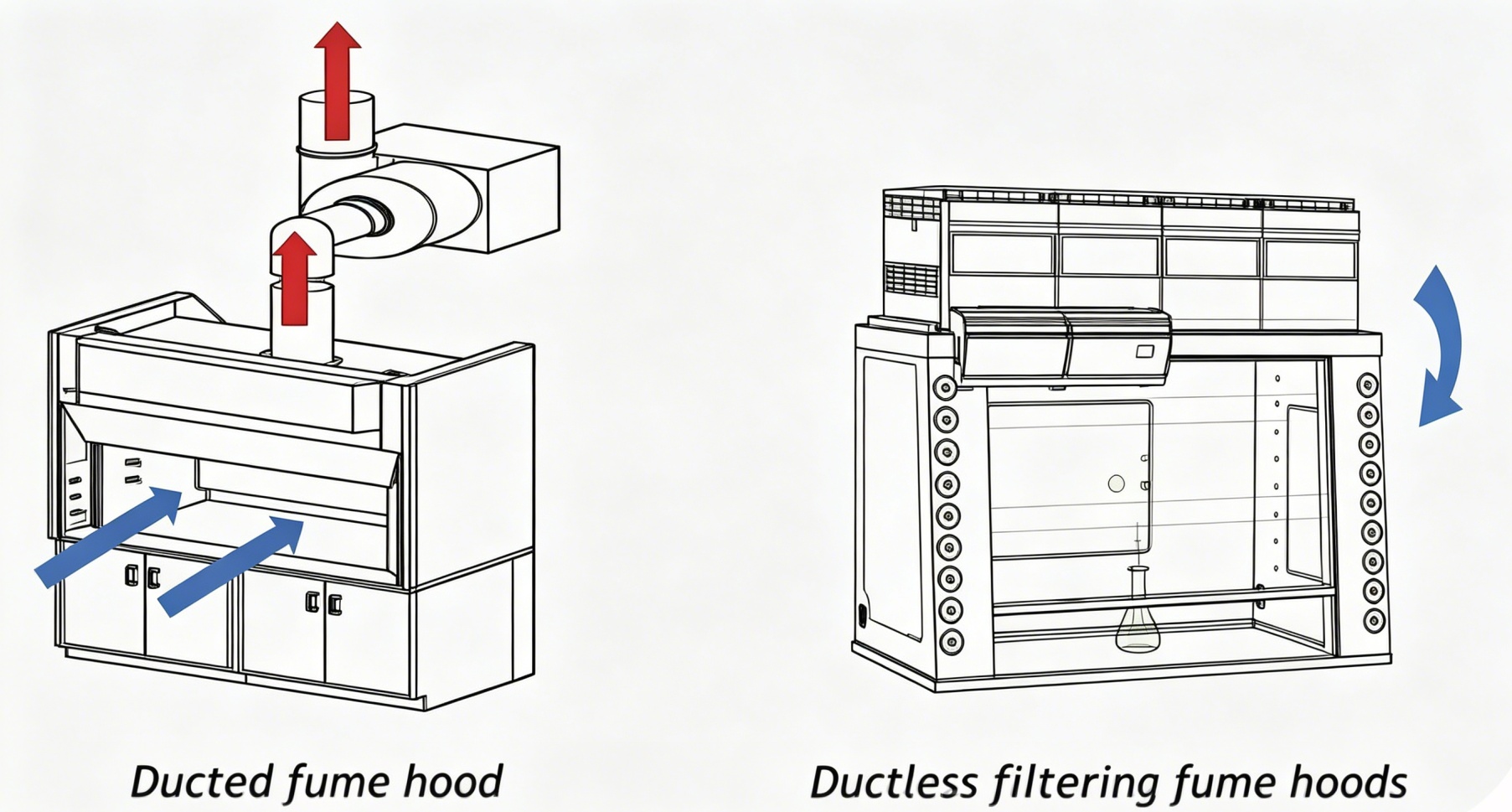
The core difference between ductless and ducted fume hoods lies in how they handle contaminated air, which determines their overall functional characteristics and application scope.
A ducted fume hood, also known as a vented fume hood, relies on a dedicated duct system connected to the building’s ventilation infrastructure. It operates by drawing hazardous air from the work area into the hood through negative pressure, then transporting the contaminated air through the duct work to an external exhaust fan, which finally discharges the pollutants outdoors away from the workspace. This design ensures that harmful substances are completely removed from the indoor environment, without the risk of secondary pollution caused by re-circulation.
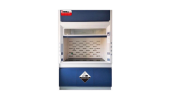
In contrast, a ductless fume hood (also called a recirculating or filtered fume hood) is a self-contained system that does not require external duct work. It captures contaminated air through internal blowers, passes the air through multi-stage filtration systems (typically activated carbon filters for organic vapors, HEPA filters for particulates, or specialty filters for acids and ammonia), and then recirculates the purified air back into the laboratory or workspace. Its safety depends entirely on the efficiency and compatibility of the filtration system, which must be selected based on the specific type of hazardous substances involved.
Installation complexity is another key distinction between the two types, directly affecting their applicability in different venues.
Ducted fume hood installation requires comprehensive engineering design and construction. It needs to be connected to the building’s central ventilation system, involving duct layout, exhaust fan installation, and air balance adjustment. In addition, professional engineers are required to certify the installation to ensure compliance with occupational health and safety regulations, such as ASHRAE 110 and CSA-Z-316.5 standards. This process is time-consuming, labor-intensive, and may require structural modifications to the building, making it less suitable for old buildings, temporary work spaces, or venues where duct work installation is impractical.
Ductless fume hoods, on the other hand, feature simple installation. They are lightweight, portable (some models are equipped with casters), and only require a stable power supply to operate, without the need for duct work or wall penetration. This flexibility allows them to be easily relocated or reconfigured as laboratory needs change, making them ideal for teaching labs, small-scale pharmaceutical work, or rented spaces where permanent modifications are not allowed.
The choice between ductless and ducted fume hoods is largely determined by the type and risk level of the hazardous substances handled in the workspace.
Ducted fume hoods are the preferred choice for environments handling high-risk, unpredictable, or large quantities of hazardous materials. They are particularly suitable for research laboratories, chemical production facilities, and industrial workshops where volatile solvents, corrosive acids, radioactive substances, or unknown chemical mixtures are used. Since they discharge contaminants directly outdoors, they eliminate the risk of filter saturation and secondary pollution, providing the highest level of protection for operators and the environment.
Ductless fume hoods are more suitable for controlled, low-risk work scenarios involving known hazardous substances with low concentrations. Typical applications include school science labs, routine testing laboratories, and small-scale experimental spaces where the types of fumes (such as low-concentration organic solvents or non-toxic particulates) are clear and stable. They are not recommended for handling highly toxic, explosive, or high-concentration substances, as filter failure could lead to the release of harmful contaminants into the workspace.
The two types of fume hoods also differ significantly in initial purchase, installation, and long-term maintenance costs, which is an important factor for enterprises to consider in budget planning.
Ducted fume hoods have higher initial costs, including the price of the equipment itself, duct work materials, installation labor, and permits. In the long term, they also require regular maintenance of duct work (inspection, cleaning, and repair) and exhaust fans. However, they do not require frequent filter replacement, reducing long-term consumable costs.
Ductless fume hoods have lower initial investment and installation costs, as they eliminate the need for duct work and complex construction. Their main long-term cost comes from filter replacement, which depends on the frequency of use and the type of contaminants. Replacement is typically required every 3 to 12 months depending on usage intensity. Additionally, they consume less energy than ducted models, as they do not require the continuous operation of large exhaust fans to discharge air outdoors.
In terms of environmental protection, the two types of fume hoods have distinct impacts.
Ducted fume hoods discharge unfiltered contaminated air directly outdoors, which may cause environmental pollution if the pollutants are not treated in advance. In some regions, this requires additional exhaust gas treatment equipment to meet environmental emission standards, increasing overall costs.
Ductless fume hoods recirculate filtered air, reducing energy consumption and avoiding outdoor pollution. They are more in line with the concept of energy conservation and environmental protection, especially in areas with strict environmental emission regulations. However, they must comply with relevant standards for filter efficiency and replacement cycles to ensure that the recirculated air meets safety requirements, and regular filter testing and replacement are mandatory to maintain compliance with occupational health standards.
Ductless and ducted fume hoods each have their own advantages and limitations, and their selection should be based on the specific needs of the workspace. Ducted fume hoods are suitable for high-risk environments requiring thorough pollutant discharge, while ductless fume hoods offer flexibility and cost-effectiveness for low-risk, controlled scenarios. By understanding the differences in working principles, installation requirements, application scenarios, and operational costs, enterprises and laboratories can make informed decisions, ensuring both operational safety and economic efficiency.
Whether choosing a ductless or ducted fume hood, it is essential to select products that meet international standards (such as ASHRAE 110, EN 14175-3) and conduct regular maintenance and testing to ensure their long-term safe and effective operation.

WUXI TECHELLIN
 WhatsApp
 Product Category
Safety Storage Management
Special Protection & Containment Solution
Lab Safety Proposal
Product Category
Safety Storage Management
Special Protection & Containment Solution
Lab Safety Proposal
 Solution
Industry Safety Solutions
Custom Laboratory Solutions
Transportation Safety Solutions
Solution
Industry Safety Solutions
Custom Laboratory Solutions
Transportation Safety Solutions
 Quick Links
Info Center
About Us
Contact
Quick Links
Info Center
About Us
Contact
 Contact Us
(+86) 510 8388 1213
(+86) 18168903951, (+86) 18168903961
No.61 HuaiRen Road, Donggang Town, Xishan District, Wuxi, Jiangsu, China

 English
  English
 Russian
 French
 Spanish